

History of the Tongan Pa'anga
Pound
Pound was the first currency of Tonga - initially British Currency circulated until 1967.
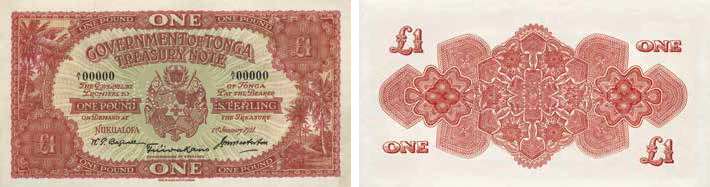
1921 Series
- Subdivided into 20 shillings, each of 12 pence.
- Was supplemented by banknotes issued by the Tongan Government.
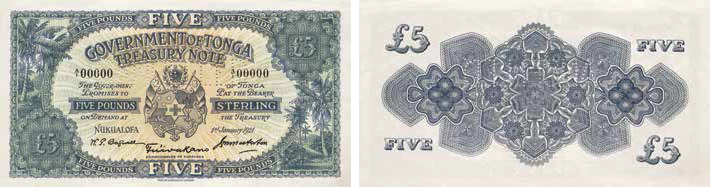
Introduction of 5 Pound
- 5 pounds were introduced followed by 4 and 10 shillings and 1 pound.
- Notes were marked as sterling and included the rather unusual 4 shillings denominations.
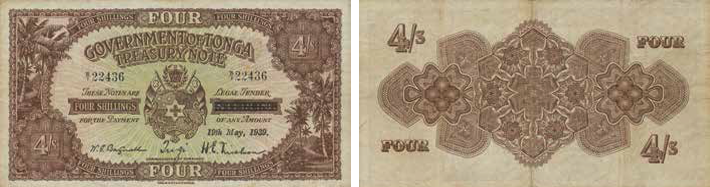
Tongan Pound Devalued
- Tongan pound was devalued to 1.25 Tonga pounds = 1 pound sterling.
- Tongan pound equal to the Australian pound, which has been devalued.
- 4 denominations were issued until 1966.
- Later issues of banknotes had the word “Sterling” crossed out, and later removed altogether.
Pa'anga
April 3rd, 1967 - The Pound was replaced by the Pa'anga at a rate of 1 Pound = 2 Pa'anga.
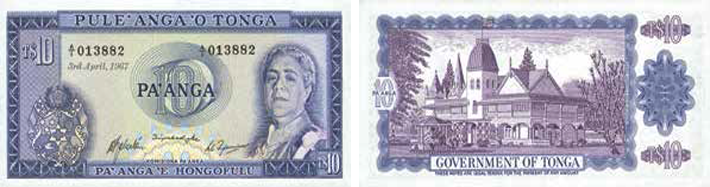
Introduction of Pa'anga
- Notes (bearing the portrait of Queen Salote Tupou III) were introduced by the Government in denominations of ½, 1, 2, 5, and 10 pa’anga.
- Coins also were introduced in denominations of 1, 2, 5. 10, 20, and 50 seniti and 1 pa’anga.
- The 1 and 2 seniti were struck in bronze with the other denominations in cupro-nickel.
- 50 seniti and 1 pa’anga were only struck in small numbers as these denominations were also issued in note form.
- Dodecagonal 50 seniti were also introduced.
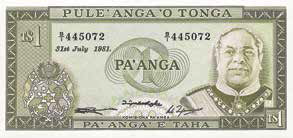
Queen Salote Tupou III Portrait Replaced
- Portrait of King Taufa’āhau Tupou IV (who reigned as King from 16 December 1965 to 10 September 2006) appeared on the notes.
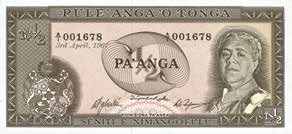
Discontinuance of the ½ Pa’anga note
- The ½ pa’anga note was no longer issued.
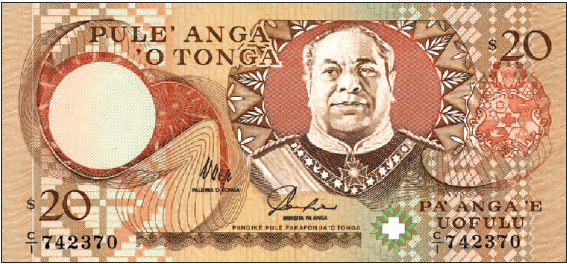
Introduction of the 20 Pa'anga note
- The 20 pa’anga notes were first introduced, bearing the portrait of His Majesty King Taufa’āhau Tupou IV on the obverse side, and the Tonga Development Bank building on the reverse side.
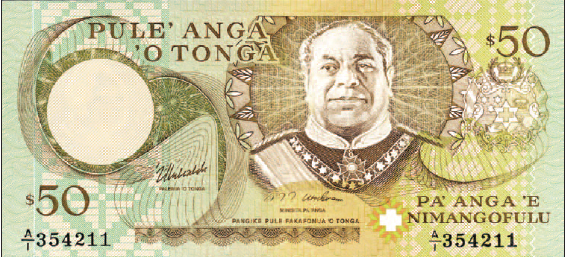
Introduction of 50 Pa'anga note
- The 50 pa’anga notes were first introduced, bearing the portrait of His Majesty King Taufa’āhau Tupou IV on the obverse side, and the Vava'u Harbour on the reverse side.

Reserve Bank given sole right to issue currency
Referring to NRBT Act, on July 1st, sole right was given to the Bank to issue currency in the Kingdom and no other person shall issue currency or any documents or tokens payable to bearer on demand having the appearance of or purporting to be currency.
TOP pegged to AUD
February 11th, the Pa’anga was pegged to the Australian dollar at par.
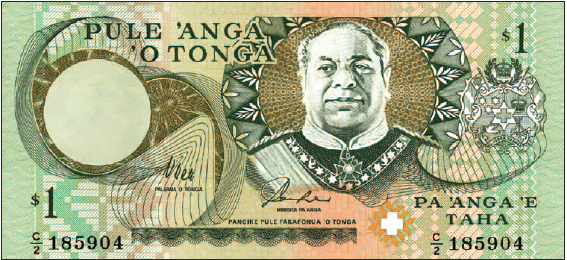
Production of paper money
The National Reserve Bank of Tonga took over new production of paper money.
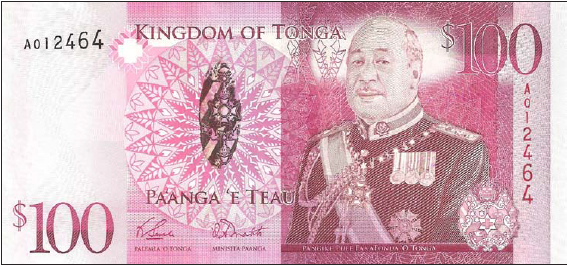
Introduction of the 100 Pa'anga Note
The 100 pa’anga note was first introduced, bearing the portrait of His Majesty King George Tupou V on the obverse side, and the Vava'u Harbour on the reverse side.
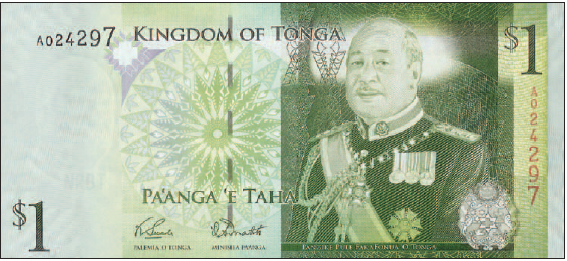
Introduction of the 2008 Series
On 21st January 2009, the National Reserve Bank of Tonga issued newly designed banknotes in the denominations of 1, 2, 5, 10, 20 and 50 pa'anga. His Majesty King George Tupou V portrait replaces his late Majesty King Taufa’āhau Tupou IV portrait.
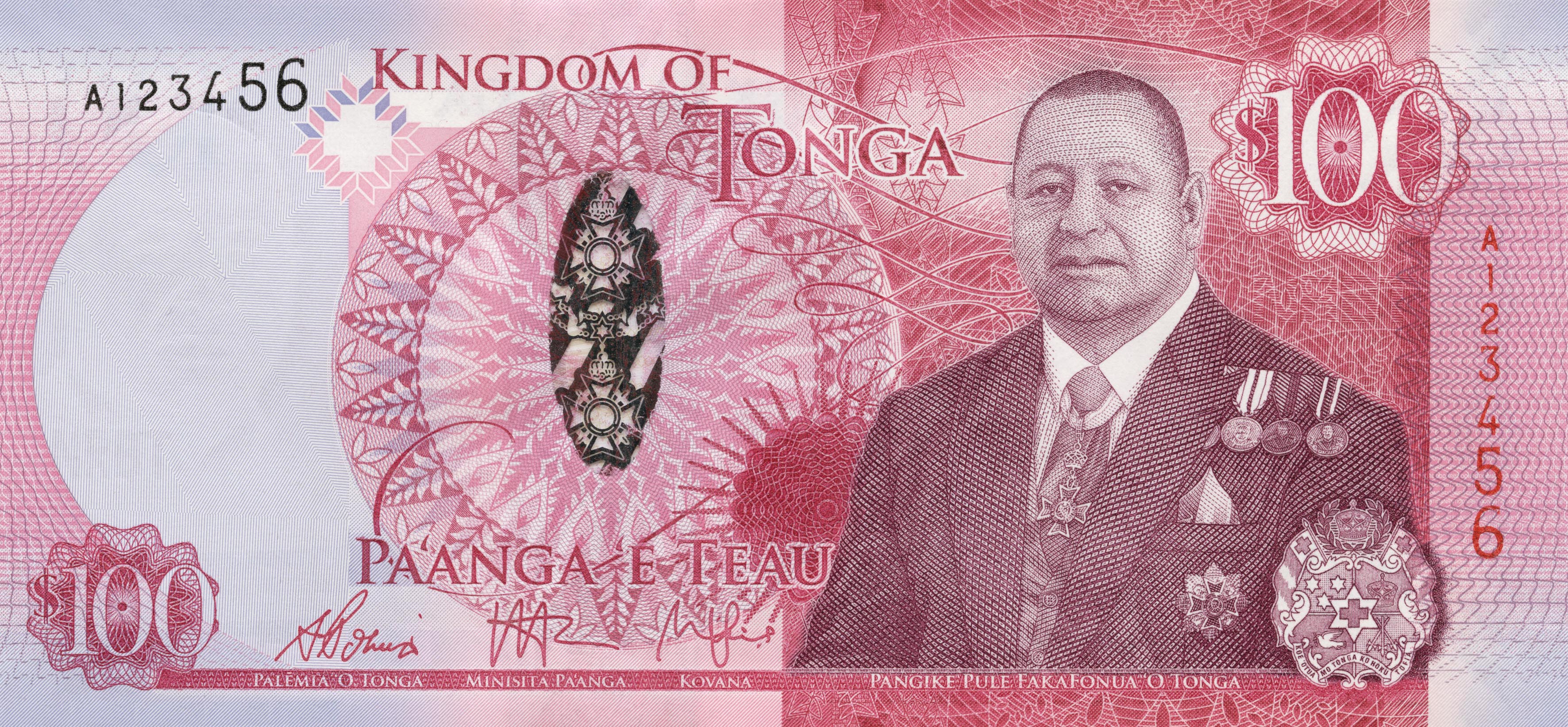
Issue of the 2015 Banknotes & Coins
- Introducing His Majesty King Tupou VI portrait on all bank notes
- Coining of $1 with the portrait of His Majesty King George Tupou V
- Introducing His Majesty King Tupou VI portrait on 5, 10, 20, 50 seniti
- Discontinuance of the 1 and 2 seniti

Issue of the 2023 Banknotes
Introducing the first polymer bank notes in the $5 and $10 Pa’anga notes.
 The National Reserve Bank of Tonga (Reserve Bank) was established on 1 July 1989 as the central bank of Tonga.