

- Monthly Economic Update - August 2026 DOWNLOAD THE FULL UPDATE | PDF • 605 KB
Outlook
Amid ongoing geopolitical tensions in the Middle East and heightened global uncertainties, risks from disruptions in international markets, trade flows, and activity in major trading partners remain elevated. These developments are expected to weigh on Tonga’s economic performance through increased market risks and volatility. In addition, prevailing El Niño conditions may further constrain agricultural production and heighten vulnerability to climate-related shocks.
Inflation remains highly uncertain and will depend on the evolution of the conflict and global commodity markets as well as local food production. Elevated global oil prices are expected to increase the cost of goods and services, with inflationary pressures potentially persisting if prices remain elevated. Given Tonga’s limited domestic production capacity and import dependence, the risk of external cost pressures passing through to domestic prices remains high. El Niño conditions could further add to inflation risks through impacts on food supply and prices.
Official foreign reserves are expected to remain above the IMF’s prescribed level of 7.5 months of import coverage in the near term, sustained by continued external receipts. While reserves are projected to remain adequate over the medium term, the outlook remains uncertain and tilted to the downside given Tonga’s high import dependence, geopolitical tensions and global commodity prices, and supply-chain shocks.
The financial system remains sound, supported by strong capital positions and adequate liquidity conditions. Credit growth is expected to remain positive in the near term, supported by initiatives to improve access to finance and Government policies aimed at promoting private sector development. Vulnerabilities to asset quality will continue to be managed through effective oversight and prudent risk management.
Against this backdrop, the NRBT will seek close coordination with fiscal policy to address emerging risks and support macroeconomic stability. The NRBT will continue its notes issuance programme to absorb excess liquidity and improve monetary policy transmission, alongside efforts to strengthen liquidity management, revive the interbank market, modernise payment systems, and further develop financial markets.
Energy shocks continued to weigh on global growth
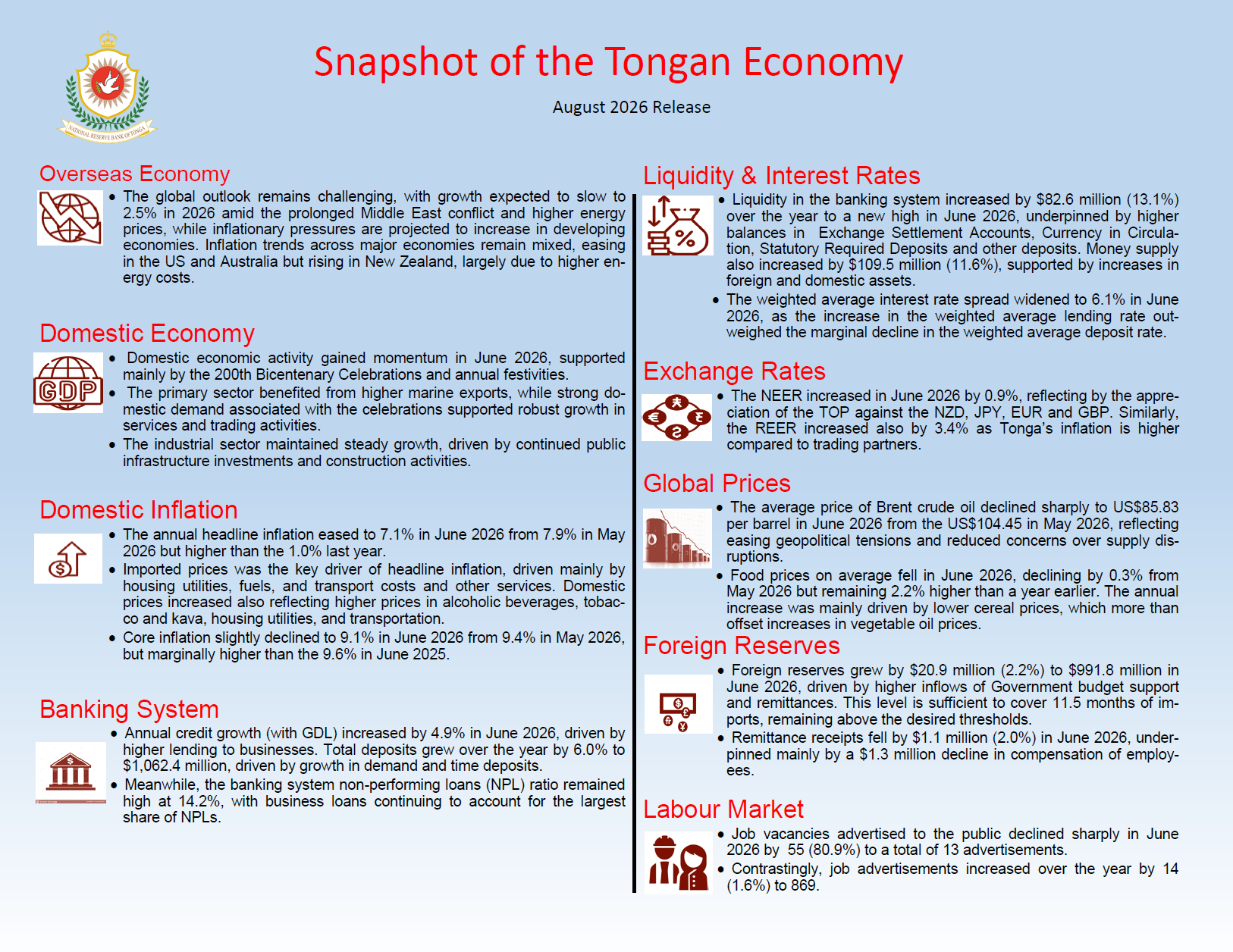
The Middle East conflict continues to weigh heavily on the global outlook, as energy shocks drive higher energy prices. Consequently, the World Economic Situation and Prospects as of mid-2026 projects global growth to slow to 2.5% in 2026 before edging up to 2.8% in 2027.
Global headline inflation in developing economies is expected to rise from 4.2% in 2025 to 5.2% in 2026. While energy prices in the US continued to surge, food prices helped drive a marginal decrease in inflation to 3.4% in July 2026 compared with 3.5% in the previous month. Australia’s annual inflation eased to 3.8% in June 2026 while New Zealand’s inflation edged up to 4.1% in June 2026, reflecting the continuing energy shock from the Middle East conflict. Market interest rates are pricing in possibilities of further hikes in official rates by these jurisdictions to address inflationary concerns. These decisions will have an impact on Tonga’s inflation and foreign reserves.
Domestic activity gained momentum in June 2026
Agricultural export volumes fell by 92.7 tonnes (12.2%) to 667.8 tonnes in June 2026, mainly due to lower cassava and taro exports, partly offset by higher yam and kava exports. This coincided with a decline in export proceeds by $0.4 million (32.1%) to $0.7 million. Over the year, agricultural export volumes increased by 1,079.1 tonnes (14.3%) to 8,635.0 tonnes, led by higher watermelon, yam, taro, and other exports, while proceeds rose by $3.9 million (66.9%) to $9.8 million. Meanwhile, marine exports increased to 93.3 tonnes, supported by tuna and shark meat, while aquarium exports rebounded to 1,153 pieces (132.9%). This coincided with an increase in proceeds by $0.40 million (241.9%) to $0.56 million. Annually, marine exports fell by 43.4 tonnes (3.9%) to 1,059.9 tonnes, though aquarium exports increased by 50,903 pieces (81.8%). Proceeds rose by $0.3 million (14.3%) to $2.19 million. In the meantime, local market marine products declined by 0.3 tonnes (5.2%) to 5.1 tonnes in June 2026, although tuna catches increased by 184.4 tonnes (111.6%). Annually, local marine products fell by 19.8 tonnes (18.0%) to 89.9 tonnes, while tuna catches increased by 255.2 tonnes (16.1%) to 1,841.5 tonnes.
In June 2026, the secondary sector maintained momentum, supported by public infrastructure investments. Construction activity remained centred on the new Parliament building and upgrades to Vaiola Hospital. However, higher wholesale diesel costs contributed to a 2.8 percent increase in electricity tariffs, raising production costs and putting pressure on industrial margins. In response, the Government accelerated investments in renewable energy and grid infrastructure under TERM PLUS to strengthen energy resilience and reduce longer-term cost pressures.
Services sector activity gained momentum in June 2026, reflecting stronger domestic spending and tourism activity. Container registrations increased by 626 (86.9%) to 1,346, while non-oil import payments rose by $13.6 million (32.5%) to $55.6 million, indicating increased demand for goods and services associated with the 200th Bicentenary Celebrations and annual festivities. Vehicle registrations also increased by 144 (56.3%) to 400, further supporting higher domestic economic activity. In year-ended terms, container registrations declined by 599 (4.8%) to 11,944, while non-oil import payments fell by $12.2 million (2.1%) to $567.6 million. Tourism activity expanded in June 2026, with visitor arrivals increasing by 3,978 (45.0%) to 12,827, supported by the Bicentenary Celebrations, annual church conferences and the Heilala Week. Travel receipts rose by $1.1 million (6.0%) to $19.6 million in June 2026, while annual receipts increased by $31.2 million (17.6%) to $208.9 million, providing further support to services activity and overall economic growth.
Headline inflation increased to 9.3%
Annual headline inflation eased to 7.1% in June 2026, down from 7.9% in May 2026 but higher than the 1.0% a year earlier. Imported prices increased by 13.2%, driven mainly by housing, utilities, fuels, and transport costs, while domestic prices rose by 2.0%, reflecting higher costs for alcoholic beverages, tobacco and kava, housing utilities, and transportation.
On a monthly basis, the Consumer Price Index increased by 1.9%, stemmed by higher imported and domestic prices. Imported prices rose by 1.3%, led by food and non-alcoholic beverages, alcoholic beverages, tobacco and kava, while domestic prices increased by 2.4%, supported by food and non-alcoholic beverages, restaurants and hotels.
Core inflation eased to 9.1% in June 2026, from 9.4% in May 2026, but remained above at 9.6% a year earlier. The 10% trimmed mean also fell to 9.5% from 9.6% in May 2026 but remained higher at 5.3% a year earlier, indicating persistent underlying price pressures.
Job advertisements declined
Job advertisements fell sharply in June 2026, with 13 vacancies advertised compared to 68 in May, reflecting the public sector recruitment freeze at the end of the fiscal year. Over the year to June, job advertisements increased slightly by 14 vacancies (1.6%) to 869, indicating broadly stable labour demand despite the sharp monthly decline.
Effective exchange rates rose
The Nominal Effective Exchange Rate (NEER) increased by 0.7% in June 2026, reflecting the appreciation of the TOP against the NZD, AUD, FJD and EUR. Over the year, NEER recorded an increased by 0.9%, as the TOP appreciated against all the trading currencies except for the AUD, FJD, USD and CNY. However, the Real Effective Exchange Rate rose over the month and year by 0.5% and 3.4%, respectively.
Foreign reserves increased
In June 2026, foreign reserves increased by $20.9 million (2.2%) to $991.8 million, underpinned by higher net inflows of Government budget support and remittances. This is equivalent to 11.5 months of import coverage, above the optimal threshold of 7.5 months. Over the year, foreign reserve increased by $66.7 million (7.2%).
Remittances fell
Remittances receipts fell by $1.1 million (2.0%) in June 2026, driven by a $1.3 million decline in in compensation of employees, partly offset by a modest $0.2 million rise in private transfers. Private capital and social benefits remained unchanged. All three major currency sources recorded declines, with the largest decrease observed in NZD remittances, which fell by $1.1 million (2.0%). AUD remittances also declined by $0.4 million (1.6%), while USD remittances decreased by $0.2 million (1.0%).
Monetary aggregates climbed to new highs in June 2026
In June 2026, reserve money (liquidity) rose to its highest level, reaching $713. 6 million, an increase of $29.6 million (4.3%) over the month and $82.6 million (13.1%) compared to June 2025. Growth was broad-based across all categories, led by Exchange Settlement Accounts (ESA), followed by Currency in Circulation (CIC), Statutory Required Deposits (SRD) and other deposits, primarily reserve bank notes.
Broad money also increased to a record $1,055.5 million, rising by $11.2 million (1.1%) over the month and $109.5 million (11.6%) annually. Net foreign assets increased both monthly and annually in line with higher foreign reserves. Net domestic assets declined over the month but expanded annually, driven mainly by greater NRBT note holdings and reduced deposits with the central bank.
Total lending peaked again whilst credit growth strengthened
In June 2026, the total bank lending increased, both monthly and annually, rising by 3.1% ($19.3 million) and 4.9% ($29.6 million) to a new peak of $634.5 million. Lending to both businesses and households expanded over the month and over the year.
Business lending grew in agriculture, tourism, and distribution sectors during the month, while annual growth was concentrated in agriculture, distribution, and entertainment & catering. Household lending also rose, with other personal loans driving the monthly gains, and both vehicle and other personal loans contributing to annual growth.
The Government Development Loans scheme increased over the month by 192.5% ($19.4 million) and over the year by 183.7% ($19.1 million). Meanwhile, the loan to deposit ratio eased to 56.9%, as deposits growth outpaced lending increases, both monthly and annually.
The banking system Non-Performing Loans (NPLs) to total loans ratio slightly fell to 14.2% in June 2026, compared with 14.4% recorded last month. Majority of these NPLs are business loans.
Interest rate spread widened
The weighted average interest rate spread widened by 1.9 basis points (bp) over the month and 4.2 bp annually, but remained relatively unchanged at 6.1%. Monthly movements reflected declines in deposit rates, driven by lower savings and demand deposits, which offset slight decrease in lending rates.
In year-ended terms, weighted average lending rates increased slightly while deposit rates declined. The rise in lending rates was driven by higher rates offered to businesses in professional & other services, manufacturing, and tourism sectors. Household loan rates followed the same upward trend as the monthly pattern, with all categories increasing, led by vehicle loans.
