

- Monthly Economic Update - June 2026 DOWNLOAD THE FULL UPDATE | PDF • 605 KB
Outlook
Amidst the ongoing geopolitical conflict in the Middle East and heightened global uncertainties, domestic economic activity is expected to be constrained by supply side disruptions and increasing cost of production. These developments are anticipated to exert a more immediate impact on Tonga’s economic activities. In addition, the current El Niño phenomenon is likely to compound these pressures by disrupting agricultural output and increasing vulnerability to climate-related shocks.
Inflation remains uncertain and depends on how the conflict in the Middel East evolves. Rising global oil prices are expected to push up costs for goods and services, and these pressures could persist if oil prices stay elevated. With limited domestic production capacity to absorb external shocks, there is a higher risk of cost pass-through and sustained inflationary pressure. At the same time, El Niño conditions pose additional risks to price stability, amplifying inflationary pressures.
Official foreign reserves are expected to remain above the adequacy level of 7.5 months of import coverage in the near term. However, the medium-term outlook remains uncertain and it’s expected to lower, particularly if the ongoing Middle East crisis continues.
The financial system remains sound, supported by strong capital buffers and adequate liquidity. However, credit growth and investment appetite may dampen given the escalating uncertainties in global markets leading to higher business costs and weaker demand.
Given these developments and the outlook, the NRBT and the Government will continue to coordinate closely to mitigate inflationary risks arising from the conflict. The NRBT remains committed to modernizing its monetary policy tools and strengthening transmission to ensure that it is better equipped to support financial stability and strengthen economic resilience.
Weaker Prospects for economies dependent on Energy imports
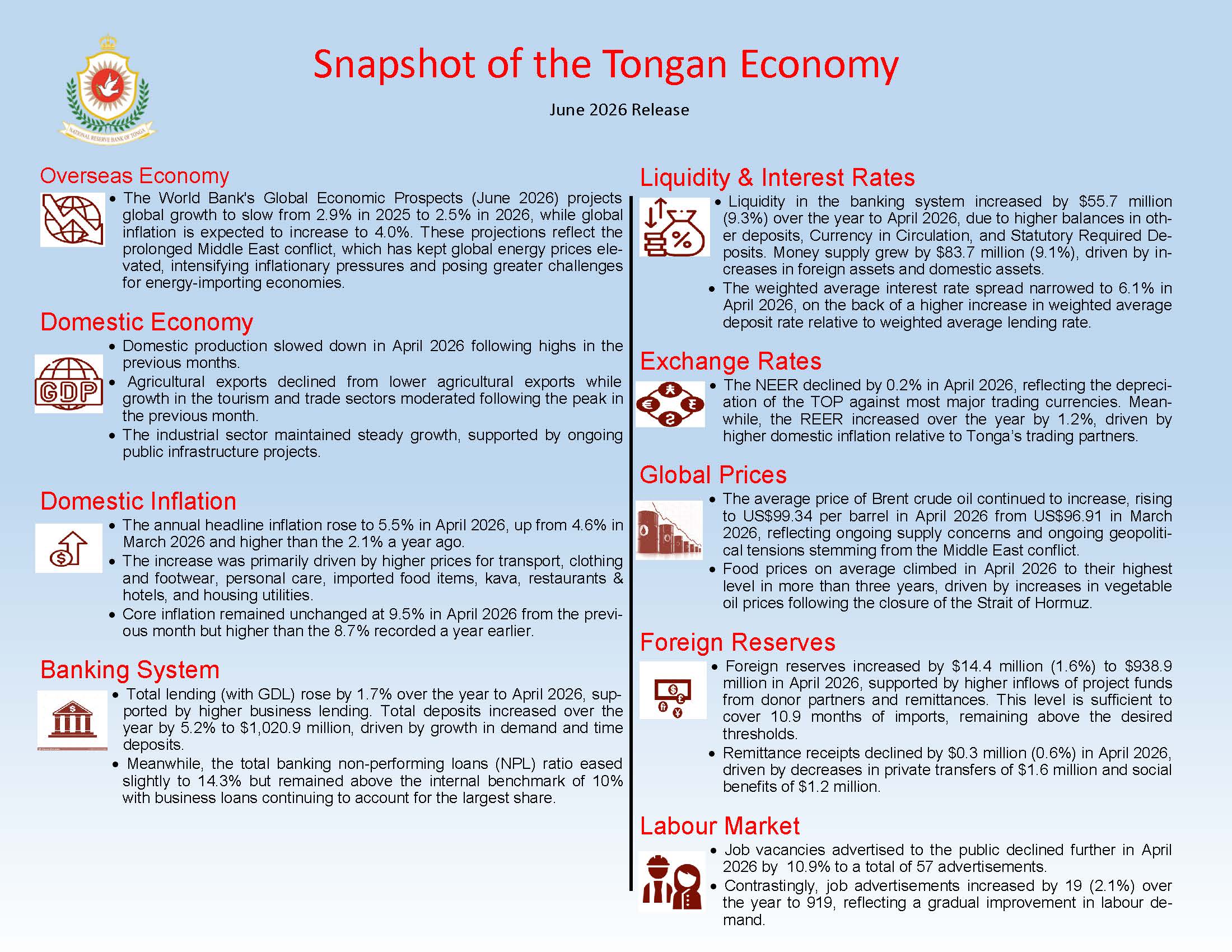
The prolonged Middle East conflict has continued to drive up energy prices, sustaining global inflationary pressures and increasing the likelihood of tighter monetary policy. Consequently, the World Bank's June 2026 Global Economic Prospects revised down its global growth forecast, projecting growth to slow from 2.9% in 2025 to 2.5% in 2026. Energy-importing economies are expected to be particularly affected, facing weaker growth prospects amid elevated fuel costs. At the same time, global headline inflation is projected to rise to 4.0% in 2026 from 2.9% in 2025, driven largely by higher energy prices.
U.S. inflation increased to 4.2% in May 2026, driven primarily by higher energy prices, while the unemployment rate remained unchanged at 4.3%. Meanwhile, Australia's economy expanded modestly by 0.3% in the first quarter of 2026, reflecting subdued household and government spending, alongside weather-related disruptions to mining and export activities. Similarly, New Zealand's economy grew by 0.8% over the same period, supported mainly by stronger manufacturing activity.
Domestic activity moderated
In April 2026, agricultural exports fell by 97.5 tonnes (14.7%) to 565.7 tonnes, mainly due to lower shipments of taro, yam, coconut, sweet potato, and other crops. This decline was partly offset by higher shipments of cassava, watermelon, and kava. Despite the lower export volume, agricultural export proceeds increased by $0.61 million (89.3%) to $1.3 million. On an annual basis, agricultural exports rose by 2,095.2 tonnes (30.8%) to 8,887.5 tonnes, underpinned by strong growth in exports of cassava, taro, yam, and watermelon. Annual export proceeds also increased by $3.8 million (70.7%) to $9.2 million, driven by higher receipts from root crops and watermelon exports.
Industrial sector activity maintained its momentum in April 2026, supported primarily by ongoing construction of the new Parliament Building and the Fanga‘uta Lagoon Bridge. Progress on nationwide road safety upgrades and the construction of Free Wesleyan Church buildings in preparation for the national bicentennial also contributed to activity. Ground-level utility infrastructure works further reinforced this momentum, including water pipeline upgrades to Vaiola Hospital and electricity grid connections to the Popua Substation. Together, these major infrastructure projects with rising private construction works sustained domestic demand across the construction, quarrying, manufacturing, and related industries.
Activity in the services sector eased in April 2026. Imported containers declined by 211 (20.1%) to 840 containers, reflecting decreases in both business and private containers by 16.5% and 39.2%, respectively. This was accompanied by a $2.1 million decline in wholesale and retail import payments, indicating softer domestic spending during the month. Over the year, total imported containers fell by 556 (4.5%) to 11,931 containers, driven by lower business imports. Meanwhile, vehicle registrations remained firm, increasing by 56 (21.5%) over the month and by 239 (7.1%) over the year to 316 and 3,627 vehicles, respectively. Travel activity, however, softened during the month, with arrivals declining by 2,534 (22.1%) to 8,956 and departures falling by 1,838 (16.2%) to 9,483. Despite lower travel volumes, travel receipts increased by $0.6 million (3.7%) to $16.3 million.
Headline inflation rose markedly to 5.5%
Annual headline inflation increased to 5.5% in April 2026, up from 4.6% in March 2026 and higher than the 2.1% a year ago. The increase was primarily driven by imported prices, which surged by 8.9%, reflecting higher prices for transport, food, housing utilities, clothing and footwear, and personal care products. Domestic prices increased by 2.5%, unchanged from March 2026, supported by higher prices for restaurants and hotels, alcohol & tobacco and kava, and housing utilities.
On a monthly basis, the Consumer Price Index (CPI) increased by 1.2%, with imported prices rising by 2.2%, led by transportation and food prices. Domestic prices recorded a modest increase of 0.2%, mainly due to higher prices for alcohol, tobacco and kava and food.
Core inflation (excluding food and energy) remained high at 9.5% in April 2026, unchanged from March 2026 but above the 8.7% recorded a year earlier. Domestic core components contributed by 4.1 percentage points, driven by increases in alcohol, tobacco and kava, restaurants and hotels, and education costs. Imported core components contributed by 5.4 percentage points, reflecting higher prices for passenger transport services and miscellaneous goods and services.
Job advertisements fell
Job advertisements declined further in April 2026, falling by 7 (10.9%) vacancies to 57 positions. The decrease was broad-based, driven mainly by fewer vacancies in the utilities and real estate and business services sectors. On an annual basis, job advertisements increased by 19 vacancies (2.1%) to 919, supported by higher demand for labour in the public administration, utilities, and transport and communication sectors.
Effective exchange rate declined
The Nominal Effective Exchange Rate (NEER) declined by 0.4% in April 2026, reflecting the depreciation of the TOP against the NZD, AUD, FJD, GBP and EUR. Over the year, the NEER recorded a 0.2% increase, as the TOP appreciated against all the trading currencies except for the AUD and FJD. Similarly, the Real Effective Exchange Rate declined over the month by 0.8% but increased over the year by 1.2% as domestic inflation continues to be higher relative to that of Tonga's trading partners.
Foreign reserves remained above the optimal thresholds
In April 2026, foreign reserves increased by $14.4 million (1.6%) to $938.9 million, underpinned by inflows of project funds from donor partners. This level is sufficient to cover 10.9 months of imports, remaining above the desired thresholds. Over the year, foreign reserve increased by $71.4 million.
Remittances declined
Remittance receipts declined by $0.3 million (0.6%) in April 2026, driven by a $1.6 million decrease in private transfers and a $1.2 million decline in social benefits. These declines were partly offset by increases in compensation of employees and private capital transfers by $1.2 million and $0.1 million, respectively. By currency, NZD remittance receipts declined by $0.8 million, in contrast to increases in AUD and USD remittance receipts by $0.7 million and $0.1 million, respectively. Over the year, remittances increased by $59.0 million (11.0%) to $595.6 million, supported by higher financial supports from families abroad.
Reserve money rose while broad money declined
Reserve money (liquidity) increased over the month and over the year in April 2026, by $5.4 million (0.8%) and $55.7 million (9.3%) respectively. Over the month the Exchange Settlement Accounts (ESA), Other deposits which includes Reserve Bank notes and Statutory Required Deposits (SRD) increased and outweighed the lower Currency in Circulation (CIC). Annually, other deposits, CIC, and SRD increased and offset the decline in ESA.
Broad money contracted by $5.9 million (0.6%) over the month but expanded annually by $83.7 million (9.1%). The monthly decline reflected a $13.9 million decrease in net domestic assets. Annual growth was underpinned by a $61.7 million increase in net foreign assets together with a $21.7 million rise in net domestic assets. At the same time, total bank deposits increased by $8.2 million (0.8%) over the month to $1,020.9 million, as all categories of deposits rose.
Total lending increased
Total bank lending grew over the month and annually by $2.2 million (0.4%) and $10.1 million (1.7%) to $607.9 million, in April 2026. The monthly rise stemmed from increased lending to public enterprises and businesses such as professional services, entertainment & catering and utilities sectors. Household loans on the other hand fell, due to lower housing and vehicle loans. Annually, both businesses and household loans increased, mainly for businesses within the constructions, distributions and professional & other services sectors, along with all categories of household loans.
The Government Development Loans scheme increased over the month by 10.1% ($0.7 million) but declined annually by 2.1% ($1.9 million). At the same time, the loan to deposit ratio declined to 58.9%, reflecting deposits increasing more than the rise in loans both monthly and annually.
The non-performing loans (NPLs) ratio remained unchanged at 14.3% over the month and was marginally lower than the 14.4% recorded a year earlier. Business loans continued to account for the majority of NPLs.
Interest rate spread narrowed
The weighted average interest rate spread narrowed to 6.1%, declining on both a monthly and annual basis. These declines reflected higher deposit rates offsetting increases in lending rates. Movements in deposit rates were led by demand and time deposits, while lending rate changes were driven by shifts across major business sectors and household loans, particularly vehicle loans.
